
Project Statement
We are a group of students from UCLA’s Library and Information Studies department. Our goal is to create data visualizations that examine the booking rates of Black artists in Los Angeles’ thriving nightlife scene with almost 500 music venues—a number that doesn’t even account for the hundreds of pop-up, underground warehouse events.
The most prominent electronic dance music genres played at nightlife events in LA are House and Techno—genres created by Black artists. Like many genres such as Jazz and Reggaeton, the last couple of decades have subjected House and Techno to a form of musical white-washing, with party lineups almost entirely dominated by white and non-Black DJs. Appropriation of Black musical genres to gain cultural power is a persistent form of anti-Black racism that we believe needs to be consistently interrogated and dismantled.
What is our project? Why are we doing it? Who is it for?
Our project examines the frequency and conditions under which Black artists are hired in electronic dance music nightlife events in LA. This inquiry was inspired by the global response to the murder of George Floyd in 2020, which sparked widespread protests. It led many music venues to publicly condemn anti-Black racism and pledge support for diversity, equity, and inclusion (DEI).
Noting the constant erasure of Black talent by bookers and venues, London-based artist NIKS gave these venues an easy way to follow up on their promise by launching the Black Artist Database (BAD), a publicly sourced, online list of Black artists from around the globe. Our study investigates whether these venues have pulled from BAD and upheld their DEI commitments. The data findings of our project are meant to inform Black artists of the venues and bookers that have not upheld these commitments and hold these bookers directly accountable for their promises. This DEI commitment is quantifiable, and our project invites everyone involved in nightlife—from DJs to bookers to event attendees— to explore our data findings and reflect on their role in combating anti-Black racism in the scene. Our findings are not fixed realities, and we all have a collective responsibility to uphold and advance DEI commitments. Lip service is no longer sufficient.
Who are we?
ESTEFANÍA
Estefanía is an MLIS student and a DJ/musician in the electronic music scene. She put together our narrative statement and also provided background on the nightlife world as she’s experienced it. As a non-Black Latina artist, she is committed to working against anti-Black racism and believes it is imperative to question her relationship with bookers and venues.
BLAIR
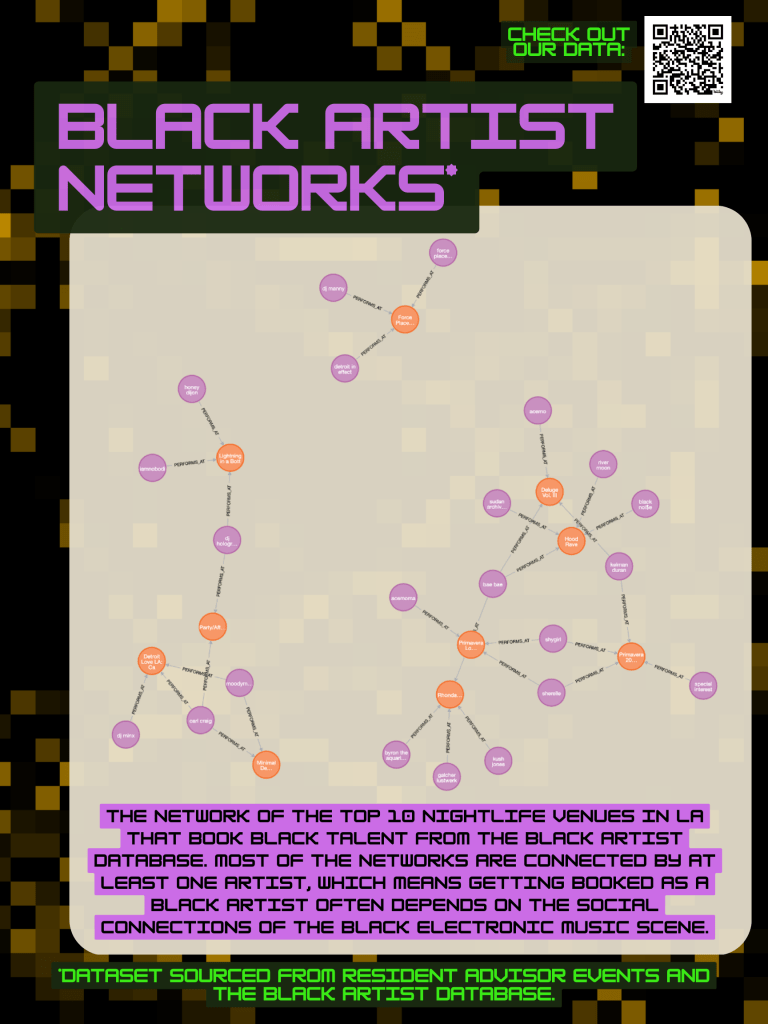
Blair is an underground dance music enthusiast whose recent-ish dissertation explored the discursive practices of how Black and Black queer DJs maintain their presence in underground EDM communities. As a second-year MLIS student, she hopes to help empower Black and Black queer artists to (re)insert themselves within electronic dance music industries and document their communities within archival records. For this project, Blair web scrapped the BAD website using Python script, Selenium, and Chrome Developer tools; and created the network analysis visualization using Neo4j Desktop and Python script.
NAT
Nat is an MLIS student and music enjoy-er. They worked on the visualizations, from helping with Tableau to designing the posters, the final version of our visualizations. They are an outsider to the physical electronic scene in LA, so their goal was to learn more and support Black artists within the scene using their unique set of skills as a designer and archivist.
ANGELA
Angela is pursuing an MLIS at UCLA. A lifelong learner and bilingual advocate, she is a dedicated library professional committed to advancing equity, diversity, and inclusion in library spaces. Her work emphasizes community building and developing programs that empower and uplift diverse and underrepresented communities. She advocates for cultural spaces that reflect and celebrate diversity. Angela worked on visualizations in Tableau and aided in the final poster visualizations.
JULIA
Julia is an artist interested in methodologies of documenting and preserving art and dance. She was excited about this project as a means of telling a narrative about an artist community while exploring structural inequalities embedded in the local scene. Julia built the web scraper to gather event data from RA’s Los Angeles events page and merged the RA dataset with the black artists dataset Blair scraped from the BAD website. She also made data visualizations in Tableau and Voyant.
Methodology: Tracing the Data Journey
DATASETS
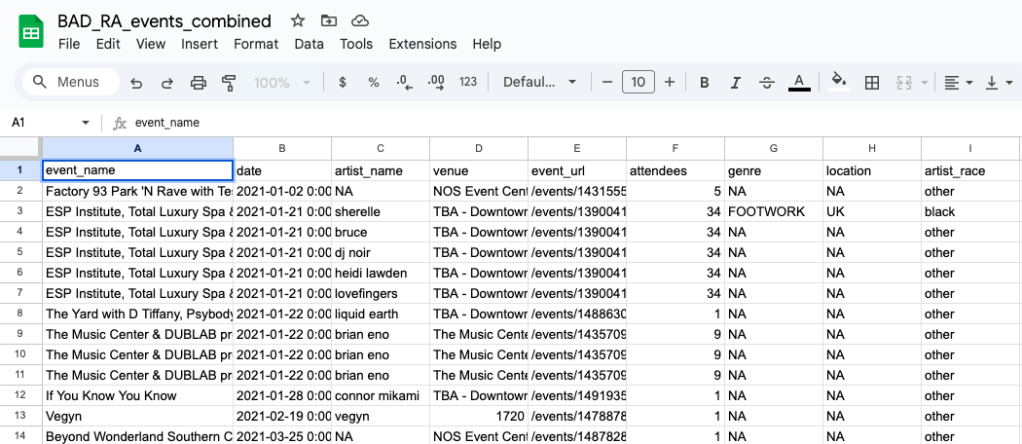
Our project utilized the Black Artist Database (BAD) and Resident Advisor (RA) event data to analyze whether BAD artists were represented in Los Angeles events from 2021 to the present. RA, a popular nightlife event aggregator, and BAD both rely on self-reported or publicly available information, meaning that some artists’ racial identities may not be explicitly identified, which could lead to potential gaps or inaccuracies in categorization. Additionally, our analysis was limited to these two platforms, which may not capture the full scope of the LA DJ scene. In particular, RA’s data is constrained by what is reported to them and the trends they establish, giving them a certain level of influence over the data. This raises the question: how can our visualizations redistribute this power?

DATA PLATFORMS & VISUALIZATIONS
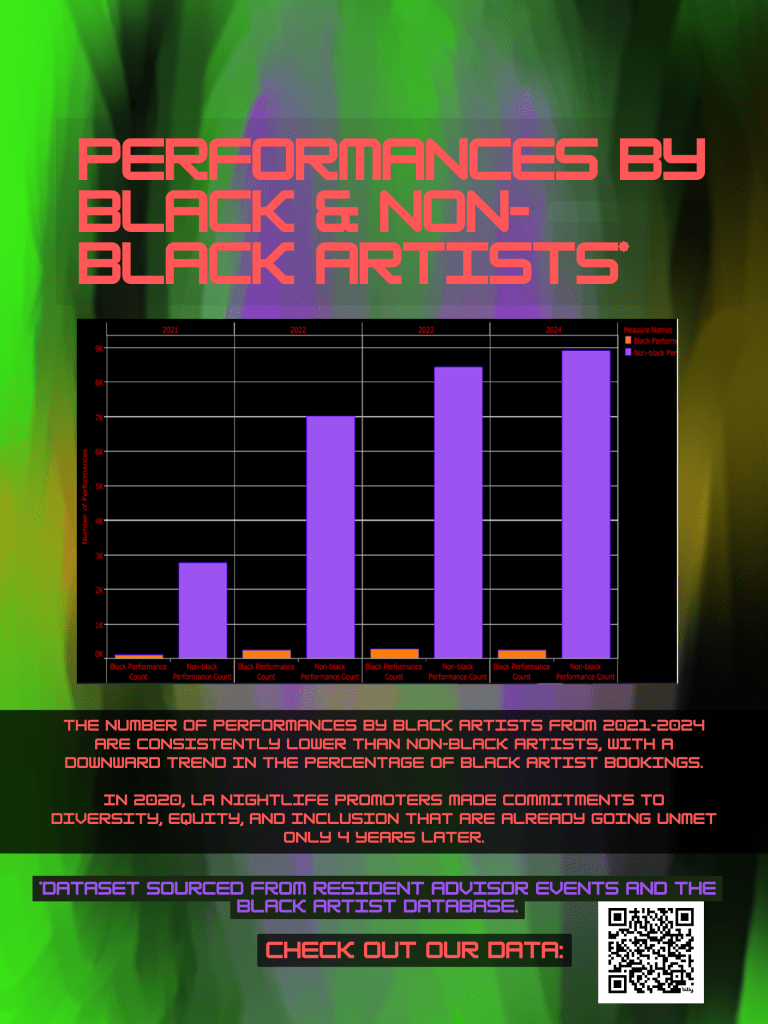
We used Tableau to create bar graphs from the data we gathered. Bar charts highlight patterns and make data accessible at a glance, which we believed would provide stark visual representations of what is occurring in the DJ nightlife scene.
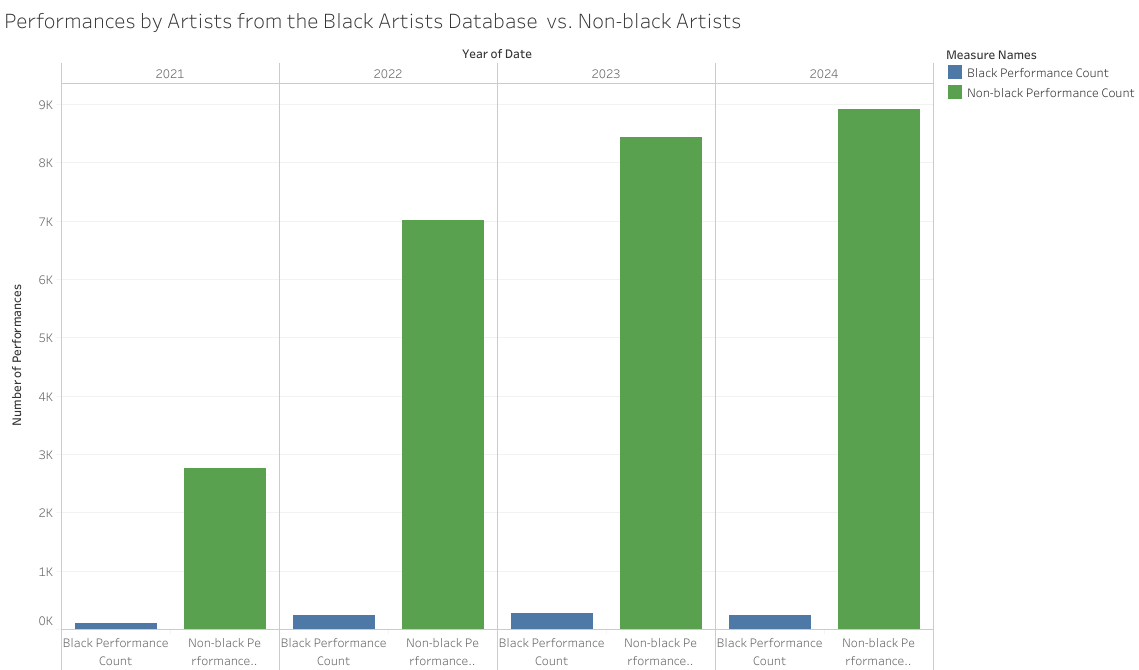
First, we imported the scraped datasets into R to identify which RA events featured artists from BAD. We created a new column to signify whether an artist was in BAD, adding relevant information from the BAD dataset. As we worked, patterns emerged and were confirmed by preliminary visualizations in Tableau, revealing that a very small and diminishing percentage of performances were from BAD artists. From here, we created a bar graph (Figure A.1) comparing the percentage of Black artists booked to non-Black artists by year.
While we cannot guarantee that all Black artists who performed are included in the database, we acknowledged this gap in our final poster. Instead of just presenting comprehensive Black artist booking rates, we used the bar graphs to show how BAD has been underutilized by bookers —a point emphasized after receiving helpful peer feedback.
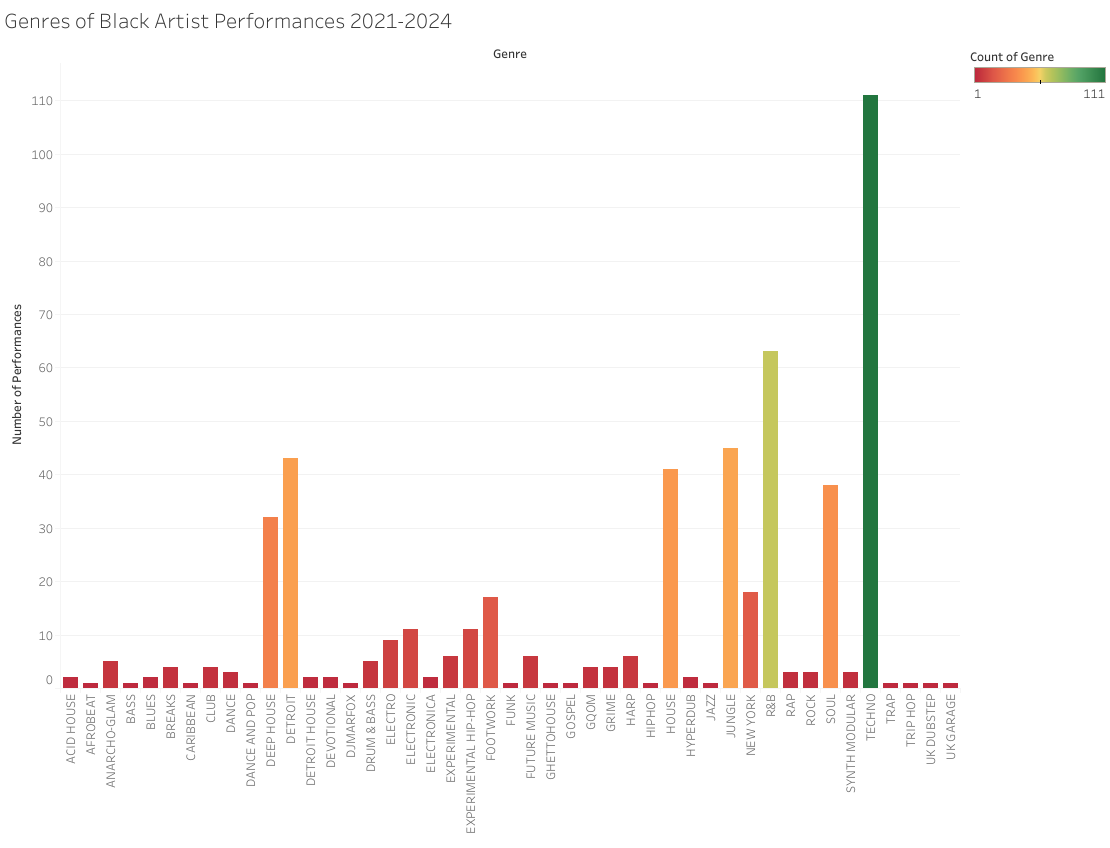
We then used Tableau to create a genre analysis visualization, examining the popularity of different music genres within the dataset. The raw data required cleaning entries such as “N/A” or invalid, non-music-related genres. We chose a bar chart (Figure A.2) to illustrate genre popularity because of its clarity and ease of interpretation. By visualizing the number of performances, we quickly identified patterns, such as which genres were most or least represented.
A classmate suggested comparing the rate of Black artists playing a given genre to the overall prevalence of that genre in the nightlife scene to provide a more accurate portrayal of the proportions of Black artist bookings. For example, Techno has the highest booking rate of Black DJs in our visualization, which indicates that Black artists are being hired in the historically Black genre. However, this data may be skewed if Techno is just the genre most performed in LA nightlife. We attempted to scrape all genre data but RA blocked us. Unfortunately, we were blocked from scraping all genre data as RA restricts access to ticket sales data for security reasons. This limitation led us to brainstorm alternative methods for gathering event aggregator data, such as reaching out to RA and other platforms for special research permissions in future iterations of this project.

We then used Neo4J to conduct a network analysis (Figure B) that provides information about the social and economic connections influencing Black booking rates. This visualization reveals potential sites to tap into for those seeking to increase the rate of Black artists booked. For instance, the network analysis can help bookers connect with more successful networks of Black artists by prompting questions such as: What venues are more successful in booking Black talent and why? Do they have partnerships or relationships with Black artists? Is there an intermediary like an identity-based collective or a promoter facilitating bookings?
Conclusions: Why Data Visualizations?
Ultimately, we consolidated our findings into three posters—emulating the aesthetics of event flyers in LA nightlife. This format resonates with nightlife participants, who are accustomed to engaging with visualizations like these on social media platforms to find out about events. Our posters serve as a conversation starter, aiming to push broader discussions and accountability processes to ensure Black artists are empowered in Los Angeles nightlife.
Visualizations

 Julia Stoddard